Haight-Ashbury: San Francisco's Counterculture District Today
What is Haight-Ashbury known for and is it worth visiting today?
Haight-Ashbury is the San Francisco neighborhood where the 1967 Summer of Love centered around the intersection of Haight and Ashbury streets. Today it mixes painted Victorian houses, vintage and record shops, and Golden Gate Park's eastern entrance with visible homelessness and panhandling, so it rewards a couple of daytime hours rather than a full day.
A Neighborhood Built Around One Summer
Haight-Ashbury takes its name from the intersection of Haight Street and Ashbury Street, a corner that, for a few crowded months in 1967, became the unofficial capital of American counterculture. Tens of thousands of young people converged on this pocket of San Francisco that summer, drawn by cheap Victorian flats, a permissive local scene, and bands rehearsing in shared houses a few blocks from Golden Gate Park. Nearly sixty years later, the neighborhood still trades heavily on that history — but it’s also a working residential district with its own daily rhythm, and visitors who show up expecting a preserved theme park are usually surprised by how ordinary most of the street looks between the landmarks.
This guide covers what actually happened here, what physically remains to see, and how to plan a visit that doesn’t waste an afternoon walking past addresses with nothing to look at.
Why the Summer of Love Happened Here
Before 1967, the Haight was a quiet, slightly down-at-heel district of large Victorian and Edwardian houses built after the 1906 earthquake, subdivided into cheap rentals as the original owners moved to newer suburbs. That combination — big shared houses, low rent, and proximity to San Francisco State and UC Berkeley students — made it a natural landing spot for a growing community of artists, musicians, and dropouts through the mid-1960s.
By January 1967, the Human Be-In in Golden Gate Park’s Polo Field had drawn an estimated 20,000–30,000 people and put the neighborhood on the national map. Bands including the Grateful Dead, Jefferson Airplane, and Janis Joplin’s Big Brother and the Holding Company lived and rehearsed in Haight-Ashbury houses, and free concerts in the park’s meadows became a regular occurrence. When the “Summer of Love” was declared for 1967, an estimated 100,000 people arrived over the following months, overwhelming a neighborhood that had never been built for that kind of population.
The scene collapsed almost as quickly as it formed. By late 1967, overcrowding, drug problems, and media attention had soured much of the original creative energy, and many of the founding figures left. What stayed behind — the housing stock, a handful of institutions, and a cultural reputation — is what visitors come to see today.
Haight and Ashbury: The Corner Itself
The intersection of Haight Street and Ashbury Street is the neighborhood’s single most-photographed spot, marked by a simple street sign that draws a steady stream of visitors taking the same photo their parents or grandparents might have taken decades earlier. There’s no plaque, museum, or formal marker beyond the sign itself — the significance is entirely historical rather than physical, which catches some first-time visitors off guard. It’s worth pausing here for a few minutes, but it isn’t a destination that needs more than that.
The Musician Houses: Look, Don’t Ring the Bell
Several addresses within a few blocks of the main corner are tied directly to 1960s musicians, and all of them are private residences today:
- 710 Ashbury Street — the Grateful Dead’s communal house from 1966–1968, where the band lived together before a well-publicized 1967 drug raid. It remains a private home; visitors photograph the exterior from the sidewalk.
- 112 Lyon Street — Janis Joplin’s residence during part of her time in San Francisco, a Victorian flat now in private hands.
- 2400 Fulton Street, facing the park, was associated with Jefferson Airplane during the same period.
None of these are open to the public, and current residents understandably don’t welcome visitors approaching the door. A respectful photo from across the street is the norm.
Haight Street Today: Shops, Not a Museum
The commercial stretch of Haight Street, roughly between Masonic Avenue and Stanyan Street, is where the neighborhood’s counterculture identity is most visibly alive in daily commerce rather than history alone. Independent record shops still sell vinyl to collectors, vintage clothing stores occupy storefronts that have changed hands but not character for decades, and a scattering of head shops and bookstores keep a bohemian retail mix that’s increasingly rare elsewhere in the city. This is also a practical shopping stretch — cafes, thrift stores, and small restaurants line the same blocks, so it works as well for browsing as for history.
It’s worth being direct about the other side of Haight Street: it has one of the more visible concentrations of homelessness and street drug use in San Francisco, a legacy in part of the neighborhood’s decades-old reputation as a landing spot for transient youth. Panhandling is common along the main commercial blocks. It’s rarely dangerous for a daytime visitor who keeps bags zipped and doesn’t linger after dark, but it’s a real part of the experience, not an exaggeration to skip past.
Golden Gate Park’s Eastern Edge
Haight-Ashbury sits directly against the eastern side of Golden Gate Park, and the two are naturally combined into one visit. Two spots inside the park carry direct 1960s history:
- The Panhandle — a narrow strip of park extending east from the main body of Golden Gate Park along Oak and Fell streets, site of free concerts and gatherings during the Summer of Love, still a green corridor used by joggers and cyclists today.
- Hippie Hill — a sloped lawn near the park’s Kezar Drive entrance, historically a gathering spot for drum circles and informal counterculture events, and still informally used that way on weekends.
Combining Haight Street with a walk into the park’s eastern meadows is the most efficient way to see the neighborhood’s history without doubling back.
Walking the Neighborhood: A Practical Route
A workable self-guided loop starts at the Haight and Ashbury intersection, runs west along Haight Street’s shops toward Stanyan, detours a block or two north to see the Ashbury Street musician houses, and finishes with a stop in the Panhandle or on Hippie Hill before continuing into Golden Gate Park proper. Done at a browsing pace with a coffee stop, this covers the neighborhood’s core in two to three hours.
For visitors who’d rather have the history explained on the spot rather than piece it together from plaques that don’t exist, a guided option removes the guesswork about which houses matter and which are just old Victorians:
a guided walking tour through Haight-Ashbury’s Summer of Love landmarks covers the main sites with a local guide who can point out details — which house belonged to which band, what the neighborhood looked like before 1967 — that aren’t posted anywhere on the street itself.
An alternative for visitors combining the Haight with more ground: a guided e-bike tour tracing Summer of Love sites covers Haight-Ashbury alongside Golden Gate Park at a faster pace, useful if time in San Francisco is tight and Haight-Ashbury is one stop among several rather than the whole afternoon.
Getting There
Haight-Ashbury has no BART station and no cable car line running through it, which surprises some visitors given how central it feels in San Francisco’s cultural geography. Muni bus routes, including the 6, 7, 33 and 37, connect the neighborhood to downtown and to the Castro and Mission District to the south and east. Street parking exists but is limited, largely metered on commercial blocks and permit-restricted on residential side streets, so a rental car is a poor fit for this particular neighborhood even though one is useful for day trips out of the city.
For visitors staying downtown or near Union Square without a fixed plan for the day, a broader city tour that includes the Haight alongside other neighborhoods can be a more efficient use of time than a dedicated trip:
a guided city highlights tour covering multiple San Francisco neighborhoods typically includes a pass through Haight-Ashbury as part of a wider loop, useful for a first visit where Haight-Ashbury is interesting but not the single priority.
Those planning to also ride San Francisco’s cable cars — which don’t reach Haight-Ashbury but do connect several other core neighborhoods — may want to pair the two experiences on the same trip: a self-guided cable car audio tour app covers the historic lines separately from a Haight-Ashbury walk, since the cable car network doesn’t extend this far west.
What’s Changed Since 1967
The most obvious change is economic. Rents in the Victorian flats that once housed communal bands and free-spirited crash pads now rank among the highest in San Francisco, and many of the original counterculture businesses have been replaced by boutiques, cafes, and the occasional chain store creeping in from the edges. The neighborhood’s population today is a mix of longtime residents, students, and young professionals drawn by the housing stock’s period character rather than any surviving commune culture.
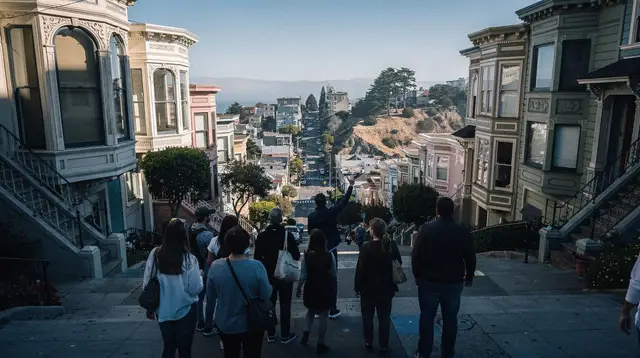
What hasn’t changed is the physical fabric: the same painted Victorian and Edwardian houses that defined the 1960s skyline are still there, largely unaltered on the outside even where interiors have been renovated into multimillion-dollar condos. That continuity — walking past the same building facades that appear in 1967 photographs — is a large part of what makes the neighborhood worth the visit, even without a formal museum or visitor center to anchor it.
Practical Notes for Visiting
| What | Detail |
|---|---|
| Best time to visit | Daytime, any season; weekday mornings are quietest |
| Time needed | 2-3 hours for the core walk; longer combined with Golden Gate Park |
| Getting there | Muni bus (lines 6, 7, 33, 37); no BART or cable car access |
| Parking | Limited, mostly metered or permit-only |
| Main free sights | Haight/Ashbury street sign, 710 Ashbury exterior, the Panhandle |
| Combine with | Golden Gate Park, Golden Gate Park’s museums, the Panhandle |
Haight-Ashbury rewards a focused couple of hours more than a full day. Visitors who pair it with Golden Gate Park get the best return on the trip — the park’s meadows carry as much Summer of Love history as the street itself, and the combined walk avoids backtracking across the city later.
Where Else to See San Francisco’s Layered History
Haight-Ashbury is one thread in a city where several neighborhoods each carry their own distinct story. Chinatown and its walking tour guide trace a completely different historical arc, while North Beach’s walking tour guide covers the city’s other major countercultural chapter, the Beat Generation of the 1950s, a full decade before the Summer of Love. Visitors building a longer itinerary around San Francisco’s neighborhoods can check the San Francisco neighborhoods guide for how the pieces fit together, or the Mission District neighborhood guide for the city’s other major counterculture-adjacent district.
For a self-directed day that strings together multiple historic corners without a set tour schedule, the self-guided walking tour of San Francisco offers a route structure that can be adapted to include Haight-Ashbury as one stop among several. Families weighing whether the neighborhood suits younger children should also check the San Francisco with kids guide, since the street-level scene along Haight Street isn’t for every age group.
Visitors planning where Haight-Ashbury fits into a broader trip can also see the first-time visitor San Francisco itinerary or the car-free San Francisco itinerary, both of which slot a Haight-Ashbury stop into a wider day without requiring a rental car. For background on how San Francisco’s fog and seasons affect an outdoor walking day like this one, the summer fog in San Francisco piece and the best time to visit San Francisco guide are useful companions, since a cold, foggy afternoon changes how comfortable a long neighborhood walk feels compared with San Francisco’s sunnier September and October window.
Haight-Ashbury FAQ: Visiting San Francisco’s Counterculture District
Is Haight-Ashbury safe to visit?
Daytime visits along Haight Street and into Golden Gate Park are routine for tourists and generally fine. The neighborhood has a visible homeless and street-drug presence, particularly on Haight Street itself and around the Panhandle, so keep bags zipped, don’t flash valuables, and expect to be asked for money more than once. Most visitors report no problems beyond that.
What is the best way to get to Haight-Ashbury?
Muni bus lines (including the 6, 7, 33 and 37) run into the neighborhood, and it’s a walkable extension from the Golden Gate Park side or the Castro. There’s no BART station nearby and no cable car line; parking is limited and mostly metered or permit-only, so public transit or a short rideshare from downtown works better than driving.
Where exactly did the Summer of Love happen?
The symbolic center is the intersection of Haight Street and Ashbury Street, marked today by a street sign that’s one of the most photographed corners in the city. The wider scene spread through the surrounding blocks of Victorian flats, along Haight Street’s storefronts, and into the adjacent Golden Gate Park meadows, notably the Panhandle and Hippie Hill near the park’s eastern edge.
Can you visit the houses associated with the Grateful Dead and Janis Joplin?
Yes, from the outside. The Grateful Dead’s former communal house at 710 Ashbury Street and Janis Joplin’s former residence at 112 Lyon Street are private homes today, not museums, so visits mean viewing and photographing the exteriors from the sidewalk rather than going inside.
How much time do you need in Haight-Ashbury?
Two to three hours covers a walk along Haight Street’s shops, a look at the Ashbury Street corner and the musician houses nearby, and a stop in the Panhandle or at Hippie Hill in Golden Gate Park. It combines naturally with a longer visit to Golden Gate Park itself, which borders the neighborhood directly.
What shopping is Haight-Ashbury known for?
Vintage clothing, independent record stores, head shops, and small bookshops line Haight Street between Masonic and Stanyan, a stretch that has kept much of its counterculture retail character even as national chains have moved into other San Francisco neighborhoods.
Is Haight-Ashbury near Golden Gate Park?
Yes. The neighborhood’s western edge runs directly into the eastern side of Golden Gate Park, including the Panhandle strip and the park meadows near Kezar Drive, so the two are typically visited together rather than as separate trips.
San Francisco by Neighborhood
Verified deep-linked GetYourGuide tours. Book through these links and we earn a small commission at no cost to you.
GetYourGuide does not provide a product photo for this activity — the image shows the meeting point, photographed by us.