North Beach Walking Tour Guide: Italian Heritage, Cafes and Telegraph Hill
What's the best way to see North Beach on foot?
A self-guided loop of roughly 2-3 hours covers Washington Square, the Italian churches and cafes along Columbus Avenue, and the climb up Telegraph Hill to Coit Tower. A guided walking or food tour adds context and local stories in about the same time, and works well combined with nearby Chinatown.
North Beach is the one San Francisco neighbourhood where a single walk stitches together Italian heritage, Beat-era literary history and one of the city’s best viewpoints, all inside an area small enough to cross on foot in twenty minutes. This guide lays out a practical route, what each stop actually involves, and where a guided tour earns its keep over going it alone.
Why North Beach rewards a slow walk
Unlike neighbourhoods built around a single headline attraction, North Beach is a layered district: 19th- and early 20th-century Italian immigration shaped its churches, cafes and delis, the Beat Generation writers of the 1950s left their mark on its bars and bookshops, and Telegraph Hill’s steep eastern flank delivers views over the bay that rival anything in San Francisco. Walking it slowly, rather than rushing between photo stops, is what makes the neighbourhood work — this is a place for lingering over an espresso, not checking boxes.
The whole area sits just uphill from Fisherman’s Wharf and immediately north of San Francisco Chinatown, so a North Beach walk fits naturally into a longer day rather than standing alone.
A neighbourhood shaped by immigration and literature
North Beach’s Italian identity took root as waves of immigrants, many from Liguria and Tuscany, settled the district from the late 1800s onward, opening the delis, bakeries and social clubs that still anchor Columbus Avenue today. That layer is easy to see: the church spires, the espresso counters, the imported-goods shops. The second layer takes more looking. In the 1950s, a small circle of poets and novelists — Allen Ginsberg, Jack Kerouac, Lawrence Ferlinghetti among them — turned the same few blocks into the epicentre of the Beat Generation, reading and drinking in bars that had already been serving the neighbourhood’s Italian community for decades. The two histories didn’t replace each other; they layered, which is part of why North Beach still feels lived-in rather than curated for visitors, unlike some more heavily touristed corners of San Francisco.
The route: Washington Square to Telegraph Hill
Start at Washington Square
Washington Square is North Beach’s civic heart, a rectangle of lawn framed by Saints Peter and Paul Church, whose twin spires appear in countless photographs of the neighbourhood. The church has anchored the local Italian-American community since the early 1900s and still holds services in Italian. Locals doing tai chi in the early morning and dog walkers at midday give the square a genuinely lived-in feel, distinct from the more tourist-dense blocks nearer the wharf.
Walk Columbus Avenue
Columbus Avenue is North Beach’s diagonal spine, cutting through the neighbourhood’s grid at an angle and lined with the delis, cafes and restaurants that define the area’s Italian character. This is where the neighbourhood’s food identity is easiest to sample on foot — pause for a cannoli, a espresso at a counter-service cafe, or a slice from a corner pizzeria. City Lights Bookstore, co-founded by poet Lawrence Ferlinghetti in 1953, sits right on this stretch and remains an independent bookshop and a landmark of the Beat Generation; next door, Vesuvio Café was a regular haunt of Jack Kerouac and Allen Ginsberg and still operates as a bar today.
A little further along, old-school Italian cafes still do brisk business alongside the newer restaurants — the kind of counter-service espresso bar where regulars read the newspaper at a marble-topped table, and delicatessens with salami and cheese hanging in the window. None of this requires a reservation or a plan; the pleasure of Columbus Avenue is ducking into whichever doorway looks most inviting and continuing on. Travellers who’d rather have someone else pick the stops can lean on a guided route instead — see the comparison further down for how the self-guided and guided versions of this same walk differ.
Climb to Telegraph Hill
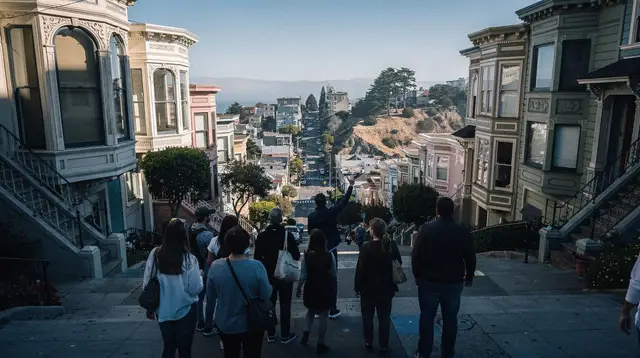
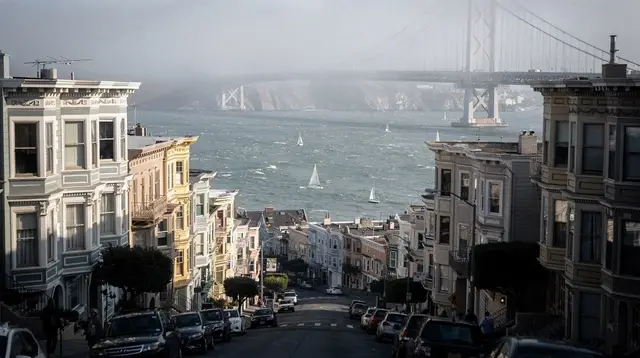
From the eastern edge of North Beach, Telegraph Hill rises sharply toward Coit Tower. The Filbert Street Steps and the parallel Greenwich Street Steps are the classic ascent: wooden and concrete stairways that climb past cottage gardens tended by neighbourhood volunteers for decades, with increasingly wide views over the bay, Alcatraz and the Bay Bridge opening up as you climb. It’s a genuine set of stairs rather than a gentle path, so pace yourself and expect to stop for the view more than once — that’s part of the point.
Coit Tower itself, at the summit, was built in 1933 and funded by a bequest from Lillie Hitchcock Coit; its base is free to visit, while the elevator to the observation deck and the WPA-era murals inside require a separate ticket. Even without going up, the viewpoint at the tower’s base is one of the best free vistas in the city.
Listen for the wild parrots
Climbers on the Filbert and Greenwich Street Steps often hear Telegraph Hill’s wild parrots before they see them — a flock of feral cherry-headed conures, descended from escaped or released pet birds, that has lived in the neighbourhood’s trees for decades and became locally famous enough to be the subject of a well-known documentary. They move as a noisy, fast-flying green flock and tend to favour the gardens partway up the steps rather than the summit itself, so it’s worth pausing mid-climb rather than only looking up once you reach Coit Tower.
Loop back or continue on
From Coit Tower, most walkers loop back down toward Washington Square, closing a circuit of roughly 2-3 hours including stops. Alternatively, the walk connects naturally downhill toward the Embarcadero, or back toward Chinatown along Broadway for a longer combined outing — see Chinatown Walking Tour Guide: Gates, Alleys and Temples for that adjoining route.
Self-guided vs. guided: how to choose
| Approach | Typical length | What you get | Best for |
|---|---|---|---|
| Self-guided walk | 2-3 hours | Full flexibility, free (aside from any food/drink stops) | Independent travellers, repeat visitors, tight budgets |
| General walking tour | 2.5-3 hours | Local guide, historical context on churches, Beat-era sites | First-time visitors wanting the story behind the streets |
| Food-focused tour | 2.5-3.5 hours | Multiple tastings at delis, bakeries or restaurants plus the walking route | Travellers prioritising food as much as sightseeing |
| Evening/ghost tour | 2-2.5 hours | North Beach’s darker history and folklore, after dark | Evening plans, visitors who’ve already done the daytime version |
A self-guided walk costs nothing beyond whatever you eat and drink along the way, and North Beach is compact and safe enough that getting lost isn’t a real risk. What a guide adds is context: which building was a speakeasy, why a particular church matters to the neighbourhood’s Italian community, which cafe Kerouac actually favoured versus which one just claims he did. For visitors who want that layer of story without researching it themselves, a guided option is worth the cost.
For a structured, guided introduction to these streets and their history, a North Beach gourmet ghost tour combining tastings with the neighbourhood’s darker folklore covers much of this same ground after dark. Travellers who’d rather prioritise the food side by daylight can look at a small-group food tour through North Beach’s delis and bakeries, or a combined food-and-history walking tour of North Beach that pairs tastings with the same Italian heritage stops described above.
For visitors who’d rather see North Beach after dark alongside its Chinatown neighbour, a night walking tour of Chinatown and North Beach covers both districts once the daytime crowds have thinned, while a Rebellious SF walking tour through Chinatown and North Beach leans into the neighbourhoods’ less official history for travellers who’ve already done a more conventional sightseeing loop.
Combining North Beach with Chinatown
Because the two neighbourhoods share a border around Broadway, many visitors treat North Beach and Chinatown as one extended walk rather than two separate outings. Chinatown’s own dense grid of markets, temples and alleyways contrasts sharply with North Beach’s Italian character just a few blocks away — see Chinatown Walking Tour Guide: Gates, Alleys and Temples for that route in detail, or consider a guided walking tour through Chinatown to bookend a North Beach visit with a guide who knows both neighbourhoods.
Travellers building a full day around this corner of the city sometimes also fold in the wharf itself; see Fisherman’s Wharf for what’s nearby, or San Francisco City Tour Guide: Bus, Van or Walking? for a broader overview that places North Beach in the context of the whole city.
Is North Beach walkable for kids, or travellers who’d rather skip the stairs?
The flat sections of the route — Washington Square, Columbus Avenue, City Lights and the surrounding cafes — are easy going for families and for anyone who’d rather not tackle stairs, and there’s enough to see and taste at street level to make a worthwhile visit without ever starting the Telegraph Hill climb. The Filbert and Greenwich Street Steps themselves are a real set of stairs with no elevator alternative, so travellers using a wheelchair or with mobility limitations should plan to enjoy North Beach’s flat blocks and skip the summit, or take a bus or taxi around to Coit Tower’s parking area instead of climbing. Kids generally do fine with the stairs at a slow pace with stops, and the parrots overhead tend to hold their attention better than the historical plaques do.
Extending the day from North Beach
North Beach’s compact size means most visitors pair it with something else. Besides the Chinatown combination already covered, a walk here fits naturally into a broader guided introduction to the city — see San Francisco Neighborhoods: A Visitor’s Guide to Where to Spend Your Time for how it compares with the city’s other districts, or Self-Guided Walking Tour of San Francisco: Build Your Own Downtown Route for a route that links several neighbourhoods, North Beach included, into one longer day. Travellers with a full week in the city sometimes use North Beach as a quieter, food-focused counterpoint to bigger-ticket days spent at Golden Gate Bridge or Alcatraz Island; see A Food Lover’s San Francisco Itinerary: Markets, Chinatown and Napa for how a North Beach walk slots into a trip built around eating well.
Practical notes
- Getting there: Several Muni bus lines serve North Beach directly, and it’s an easy uphill walk from Fisherman’s Wharf or downhill from Russian Hill. Parking is scarce and often expensive in the neighbourhood’s narrow streets, so arriving on foot, by bus, or by cable car (the Powell-Mason line stops within walking distance) is more practical than driving.
- What to wear: San Francisco’s summer fog reaches this part of the city too, so a layered jacket is worth carrying year-round, even in July and August — see Why San Francisco Summers Are Cold and Foggy for why. Comfortable shoes matter more here than almost anywhere else in the city, given the Telegraph Hill stairs.
- When to go: Late morning through early afternoon suits cafes, the bookstore and church visits; early evening shifts the mood toward North Beach’s restaurant and bar scene. For a different atmosphere entirely, an after-dark tour trades the views for the neighbourhood’s folklore, as covered above.
- Combine with other city sights: North Beach pairs naturally with a half-day that also includes San Francisco Chinatown and the western edge of Fisherman’s Wharf; for visitors planning a broader loop, San Francisco Two-Day Highlights: Alcatraz and a Sausalito Ferry and Three Days in San Francisco: A Slow, Transit-Only Plan both slot a North Beach walk in alongside the city’s bigger-ticket sights.
- Nearby tools: Before setting out, Best time to visit and Interactive Map of San Francisco can help plan timing and orientation for a walk that covers several distinct pockets of the neighbourhood.
Other ways to see this side of the city
For visitors who want North Beach as part of a wider guided introduction to San Francisco rather than a standalone walk, a San Francisco highlights tour with a guide typically threads through this neighbourhood alongside other landmark sights. And for those planning an evening that combines Alcatraz with a taste of North Beach afterward, a San Francisco Alcatraz evening ticket paired with a North Beach tour is worth considering as a single booking that covers both.
North Beach Walking Tour: Frequently Asked Questions
How long does a North Beach walking tour take?
A self-guided loop covering the main Italian heritage sites, cafes and Telegraph Hill takes roughly 2-3 hours at a relaxed pace, including a coffee or pastry stop. Guided tours, including food-focused ones, typically run 2.5-3.5 hours.
Is the Telegraph Hill climb difficult?
The Filbert Street Steps from Sansome Street up to Coit Tower gain about 60 metres over several blocks of stairs, some flanked by gardens. It’s a genuine climb, not a stroll, but manageable for most visitors at a slow pace with stops to enjoy the bay views.
Do I need to book a guide, or can I walk North Beach on my own?
North Beach is easy to explore independently with a map, since the neighbourhood is small and walkable. A guided tour is worth it for the stories behind the churches, cafes and Beat-era landmarks that aren’t obvious from the street, and food tours add tastings you can’t easily arrange yourself.
Is North Beach connected to Chinatown on foot?
Yes. North Beach sits immediately north of Chinatown, and the two neighbourhoods share a walkable border around Broadway and Columbus Avenue, making it easy to combine both in a single day on foot.
What’s the best time of day to walk North Beach?
Late morning to early afternoon works well for cafes and shops being open, while early evening suits North Beach’s restaurant and nightlife side. Remember San Francisco’s summer fog is common in this part of the city, so a jacket is worth carrying even in July and August.
Does the walking tour include Coit Tower’s interior?
Most self-guided routes and general walking tours end at the base of Coit Tower, since the elevator to the top and the interior murals require a separate paid ticket. Some specialty tours include the elevator ride; check the specific tour’s inclusions before booking.
Walking Tours of San Francisco
Verified deep-linked GetYourGuide tours. Book through these links and we earn a small commission at no cost to you.
GetYourGuide does not provide a product photo for this activity — the image shows the meeting point, photographed by us.