Chinatown Walking Tour Guide: Gates, Alleys and Temples
What's the best way to walk San Francisco's Chinatown?
Enter through the Dragon's Gate on Grant Avenue, then detour off the main tourist strip onto Waverly Place and Ross Alley to find the temples and the fortune cookie factory. A self-led loop takes about 1.5-2 hours; a guided walking tour covers the same ground in roughly 2-2.5 hours with historical context and alley access that's easy to miss alone.
Why Chinatown rewards a slow walk
San Francisco’s Chinatown is the oldest Chinatown in North America, and it shows in the layout: a tight grid of streets and even tighter alleys wedged between the Financial District and North Beach, built and rebuilt after the 1906 earthquake into the ornamental façade most visitors picture today. Most people see it in ten minutes, walking straight up Grant Avenue between the souvenir shops without ever turning off into an alley. That’s the mistake. The neighborhood’s real texture — the temples, the produce markets, the murals, the fortune cookie factory still running on a 1960s machine — sits one block over on Stockton Street and in the narrow alleys that connect the two.
This guide lays out a route that works equally well self-led with a phone map or alongside a local guide, plus the specific stops worth building time around rather than walking past.
Where to start: the Dragon’s Gate
Nearly every route through Chinatown begins at the same place: the Dragon’s Gate (also called the Chinatown Gate) at Grant Avenue and Bush Street, the formal southern entrance to the neighborhood, a few minutes’ walk from Union Square. Its green tile roofline, guardian lion statues and inscribed plaques make an obvious, photogenic starting point, and it orients you north up Grant Avenue — the direction almost every walking route follows.
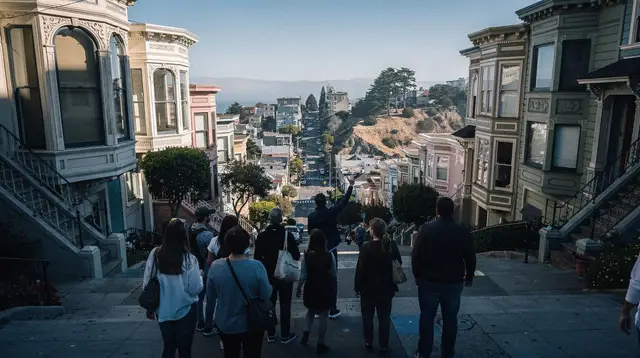
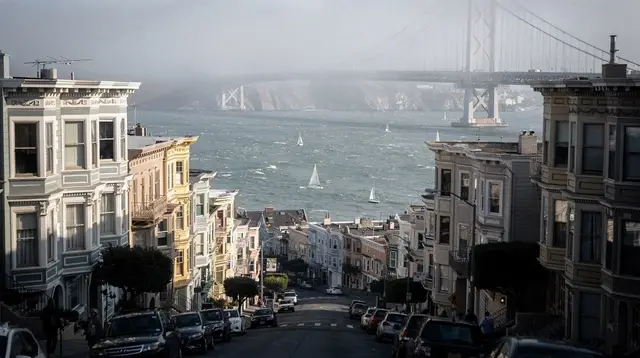
If you’re combining Chinatown with a broader look at downtown San Francisco, the San Francisco: Downtown Guided Walking Tour is worth knowing about as an option:
a downtown walking tour that threads through the Financial District before reaching Chinatown’s gateGrant Avenue: the ornamental main street
From the Dragon’s Gate, Grant Avenue runs north through the neighborhood’s most photographed stretch — pagoda-style rooflines, red lanterns strung overhead, souvenir shops selling silk, tea and jade, and a steady run of dim sum counters and bakeries. It’s worth walking slowly here, but it’s also worth knowing that Grant Avenue is largely built for visitors; the neighborhood’s day-to-day commercial life happens a block west, on Stockton Street.
Treat Grant Avenue as the spine of the walk rather than the whole trip. A few blocks in, look for Old St. Mary’s Cathedral at Grant and California — completed in 1854, damaged and rebuilt after 1906, and still an active parish tucked between souvenir storefronts.
Waverly Place: the “Street of Painted Balconies”
The single most worthwhile detour off Grant Avenue is Waverly Place, a narrow alley one block over, nicknamed the “Street of Painted Balconies” for its brightly colored, temple-topped buildings. This is where several of Chinatown’s temples sit, mostly on the upper floors of older buildings, reached by narrow stairwells that don’t look like public entrances from the street.
Tin How Temple, dedicated to the sea goddess Mazu and believed to be the oldest Taoist temple in the United States, occupies the top floor of a building on Waverly Place. It’s free to enter (a small donation is customary), but be ready for steep, narrow stairs and a modest interior thick with incense and red lanterns — quiet, functioning, and easy to miss if you don’t know to look for the unmarked doorway.
Ross Alley: murals and the fortune cookie factory
A block further, Ross Alley is Chinatown’s most atmospheric side street: narrow, shaded, lined with murals, and home to the Golden Gate Fortune Cookie Factory, a small working shop where fortune cookies have been folded by hand and machine since the 1960s. There’s usually a small fee to take photos inside, and the cookies themselves are sold fresh — a genuinely different souvenir from anything on Grant Avenue. Ross Alley has also appeared as a filming location in several movies, which local guides tend to point out if you’re walking with one.
Stockton Street: where the neighborhood actually shops
Cross back to Stockton Street to see Chinatown function as a real neighborhood rather than a tourist corridor. Produce stalls spill onto the sidewalk, whole fish sit on ice outside seafood markets, herbalist shops display dried goods in glass jars, and bakeries sell char siu bao and egg tarts to a mostly local clientele. Signage here is often Chinese-only, and the pace is brisker and less performative than Grant Avenue a block away. Morning, roughly 9am to noon, is when Stockton Street is busiest with deliveries and at its most interesting.
Portsmouth Square: the neighborhood’s living room
Heading east from Grant Avenue, Portsmouth Square functions as Chinatown’s town square — the site of the first American flag raised in San Francisco in 1846, and today a gathering spot for tai chi in the early morning, card games through the afternoon, and children on the playground built over an underground parking garage. It’s a good place to sit for ten minutes and watch the neighborhood rather than photograph it.
Eating along the way
Chinatown rewards building food stops into the route rather than saving a meal for the end. Dim sum counters along Grant Avenue and Stockton Street serve from late morning; bakeries sell egg tarts and pineapple buns as snacks between stops; and noodle shops tend to be busiest — and freshest — around lunch. If you want the food itself to be the focus of the walk rather than a stop along the way, a dedicated food-focused route covers more ground on that front than a general walking loop.
Guided route vs. self-guided route
| Self-guided walk | Guided walking tour | |
|---|---|---|
| Typical length | 1.5-2 hours | 2-2.5 hours |
| Pace | Entirely your own | Set by the group |
| Access to temples/alleys | Findable with this guide, easy to miss without it | Guide points them out directly |
| Historical context | Minimal unless researched beforehand | Built into the route |
| Cost | Free | Paid, fixed departure times |
| Best for | Independent travelers, flexible schedules | First-time visitors, history-focused travelers |
For a guided option built specifically around this neighborhood:
a local guide leads a small-group walk through Chinatown’s alleys and templesA suggested 90-minute loop
- Start at the Dragon’s Gate, Grant Avenue at Bush Street.
- Walk north on Grant Avenue, pausing at Old St. Mary’s Cathedral.
- Turn onto Waverly Place to see the painted balconies and, if open, Tin How Temple.
- Continue to Ross Alley for the murals and the fortune cookie factory.
- Cross to Stockton Street and walk it south for a few blocks to see the produce and seafood markets.
- Finish at Portsmouth Square, then continue north into North Beach if you have time left.
This loop is compact enough to combine with a self-guided walking tour of San Francisco more broadly, since Chinatown sits within easy walking distance of Union Square, the Financial District and North Beach.
Combining Chinatown with the rest of your day
Chinatown’s central location makes it easy to fold into a longer day. It sits a short walk from Fisherman’s Wharf to the north and Union Square to the south, and it works well as a midday stop on a broader San Francisco city tour or as the first stop of a one-day San Francisco itinerary.
If your day trip extends beyond the city itself, several Bay Area day tours depart from San Francisco and are worth comparing against a Chinatown-focused morning:
a full day covering Alcatraz, Muir Woods and Sausalito for those who’d rather leave the city after a Chinatown morningChinatown after dark
Most visitors walk Chinatown in daylight, but the neighborhood changes character once the shops start pulling down their metal shutters and the restaurants light up instead. Grant Avenue’s lanterns read differently against a dark sky, Ross Alley empties out, and the dim sum counters give way to sit-down dinner spots that don’t bother with a daytime lunch crowd. A guide who knows the neighborhood after hours can also point out the doorways and alley entrances that are easy to spot in daylight but disappear into shadow once the sun goes down:
an evening walking route through Chinatown and into North Beach, with a different set of stops than the daytime loopPairing Chinatown after dark with a North Beach evening works well logistically, since the two neighborhoods share a border and the walk between them takes only a few minutes.
Themed alternatives: food-first and history-first routes
The route above is a general-purpose loop, but a couple of themed alternatives cover the same streets with a sharper focus. If the food is the real draw, a route built specifically around tasting stops — dumplings, roast meats, bakeries — moves at a slower, more deliberate pace than a sightseeing walk and skips some of the purely visual stops in favor of more eating time:
a tasting-focused route through Chinatown’s bakeries, dim sum counters and specialty food shopsFor a route built around the neighborhood’s less polished history — labor disputes, tong conflicts, the parts of the story that don’t make it onto the ornamental Grant Avenue plaques — a themed history walk digs into that material more directly than a general loop has room for:
a history-focused walk covering Chinatown’s less-told stories alongside neighboring North BeachSince Chinatown sits close to the ferry terminal for Alcatraz, it’s also a natural half of a two-stop morning for visitors who want both the island and the neighborhood covered without doubling back across the city:
a combined outing pairing Alcatraz Island with a guided walk through ChinatownWhichever version you pick, it’s worth reading how walking tours compare to the hop-on-hop-off bus more broadly if Chinatown is one stop on a longer day that also covers Fisherman’s Wharf or the Golden Gate Bridge — the bus covers more ground per hour, but none of it on foot down an alley like Waverly Place.
A note on etiquette
Chinatown is a living, residential neighborhood, not a themed attraction, and a handful of small habits go a long way toward being a considerate visitor rather than an intrusive one. Keep voices down inside temples, ask before photographing shopkeepers, worshippers or the interiors of businesses, and don’t block narrow sidewalks or doorways for a photo when locals are trying to get past with groceries or deliveries. A longer rundown of do’s and don’ts lives in this Chinatown etiquette guide, and the broader Chinatown neighborhood guide covers its history and layout in more depth than a walking route has room for. For context on how Chinatown fits among San Francisco’s other neighborhoods, see the San Francisco neighborhoods guide.
Practical notes
- Getting there: Chinatown’s Dragon’s Gate is a 10-15 minute walk from Union Square, or a short ride on Muni. The California Street cable car line runs along the neighborhood’s southern edge and tends to have shorter queues than the Powell Street lines.
- What to wear: comfortable shoes matter more than usual — sidewalks are uneven in places and temple stairs are steep and narrow.
- Cash vs. card: most shops and restaurants take cards, but some smaller bakeries and market stalls are cash-only or cash-preferred.
- Photography etiquette: ask before photographing people, especially inside temples or at market stalls; some shop owners and worshippers understandably don’t want to be part of someone else’s souvenir photo.
- Crowds: Grant Avenue gets busy with tour groups from late morning through the afternoon; the alleys and Stockton Street stay comparatively quiet even then.
Chinatown walking tour: frequently asked questions
How long does it take to walk Chinatown?
A focused loop covering the Dragon’s Gate, Grant Avenue, Waverly Place, Ross Alley and Portsmouth Square takes about 1.5-2 hours at a relaxed pace. Add 30-45 minutes for a proper stop at Tin How Temple or a lingering coffee break, and budget closer to 2.5-3 hours if you’re also eating a full meal along the way.
Is Chinatown safe to walk around, including the alleys?
Yes — Chinatown’s alleys are busy, residential and commercial during the day, not hidden or dangerous. Like anywhere in San Francisco, keep bags zipped and don’t leave anything visible in a parked car nearby; the alleys themselves are simply narrow, quiet streets full of shopfronts, murals and temple entrances.
Is a guided walking tour worth it over doing it yourself?
A guide is worth it if you want the history behind what you’re seeing — why the alleys exist, what happened during the 1906 earthquake rebuild, which doorways lead to temples that aren’t obviously marked. A self-guided walk works well if you’d rather move at your own pace, stop for food when you’re hungry, and skip anything that doesn’t interest you.
Where does the Chinatown walking tour start and end?
Most routes, guided or self-led, start at the Dragon’s Gate on Grant Avenue at Bush Street and finish near Portsmouth Square or Stockton Street, a few blocks north. That puts you within easy walking distance of Union Square at the start and North Beach at the end, so it’s simple to combine with either.
What’s the difference between Grant Avenue and Stockton Street in Chinatown?
Grant Avenue is the ornamental, tourist-facing main street — pagoda rooflines, lantern strings, souvenir shops and dim sum spots. Stockton Street, one block over, is where the neighborhood actually shops: produce stalls, fish markets, bakeries and herbalists with almost no English signage. Walking both streets gives a fuller picture than either alone.
Can I visit the temples in Chinatown, and do I need to pay?
Yes, several temples welcome visitors free of charge, including Tin How Temple on Waverly Place, though a small donation is customary and appreciated. Dress and behave respectfully — keep voices down, ask before photographing altars or worshippers, and expect narrow stairs since most temples occupy upper floors of older buildings.
Should I visit Chinatown in the morning or afternoon?
Morning, roughly 9am-noon, is best for seeing the neighborhood function as a real market — produce deliveries, bakeries at their freshest, fewer tour groups. Afternoon and early evening bring more restaurants open for dim sum or dinner and livelier street activity, but also more crowds on Grant Avenue.
Is Chinatown wheelchair or stroller accessible?
Grant Avenue and Stockton Street are flat and generally manageable, but sidewalks are often narrow and can be crowded, and some of the most interesting temple entrances involve steep, narrow stairs with no elevator. A stroller is fine on the main streets; a wheelchair user may find some alleys and shop entrances difficult without help.
Walking Tours of San Francisco
Verified deep-linked GetYourGuide tours. Book through these links and we earn a small commission at no cost to you.
GetYourGuide does not provide a product photo for this activity — the image shows the meeting point, photographed by us.