San Francisco City Tour Guide: Bus, Van or Walking?
What's the best type of city tour for a first visit to San Francisco?
A hop-on hop-off bus or guided bus/van tour covers the most ground in the least time and suits most first-time visitors, since the city's hills and spread-out landmarks make full walking coverage slow. A walking tour works best for a single, dense neighborhood like Chinatown or North Beach rather than the whole city in one outing.
Three ways to cover San Francisco’s highlights in one outing
San Francisco is deceptively large for a city most visitors picture as a compact grid around Union Square. The real geography, described in the San Francisco neighborhoods guide, stretches from the Presidio and the Golden Gate Bridge in the northwest to the Mission and Castro in the south, with Fisherman’s Wharf, Chinatown, Nob Hill and SoMa strung out in between — all on hills steep enough to slow a walker considerably. That geography is exactly why the choice of tour format matters more here than in a flatter city: a bus or van covers the distance effortlessly, a bike splits the difference, and walking only makes sense once you’ve narrowed the target to a single district.
This guide compares the three realistic formats for a first overview of San Francisco — bus/van sightseeing, guided bike or e-bike routes, and walking tours — so you can match the format to your time, budget, fitness and interests before booking anything.
How the three formats actually differ
| Format | Typical duration | Ground covered | Physical effort | Best for |
|---|---|---|---|---|
| Bus / van tour | 3-4 hours | City-wide: bridge, wharf, hills, parks | Low — mostly seated | First-time visitors, limited time, limited mobility |
| Guided bike or e-bike tour | 3-4 hours | City-wide, often crosses the Golden Gate Bridge | Moderate to high (lower on e-bike) | Active travelers who want fresh air and photo stops |
| Walking tour | 2-3 hours | One neighborhood (Chinatown, North Beach, downtown) | Moderate — flat to hilly depending on route | Visitors who want depth in one area, not breadth |
None of these formats requires a rental car — a genuine advantage in a city where, as covered in the getting around San Francisco guide, parking downtown commonly runs $3-8 per hour with daily maximums of $30-60 in high-demand zones, and many streets are narrow, one-way or steeply graded.
Bus and van tours: the default choice for a first visit
A guided bus or van sightseeing tour is the closest thing to a complete overview of San Francisco in a single outing. A typical route strings together the Golden Gate Bridge and the Presidio, Fisherman’s Wharf and the Embarcadero, Chinatown, Nob Hill, and often a detour up Twin Peaks for the skyline view — territory that would take a full day and several transit transfers to cover independently.
The standard city sightseeing tour is the straightforward version of this format: a set route, a running commentary, and stops at the marquee landmarks. For travelers who also want expert narration and a smaller group, the guided highlights tour covers similar ground with more time built in at each stop.
The main trade-off is pace: a bus tour moves on a schedule, so it suits visitors who want breadth (see the bridge, the wharf, the hills, the parks) over depth at any single stop. It’s also the most weather-proof option — riders stay under cover for most of the route, which matters given San Francisco’s summer fog, covered in the summer fog guide.
Families, groups with mixed mobility, or anyone on a tight one-day schedule (see the one-day San Francisco itinerary) generally get the most value from this format, since it removes walking distance as a constraint entirely.
Private tours: the same format, on your own schedule
A private van or car tour keeps the bus-tour advantage of covering the whole city with no walking required, but removes the fixed group schedule. The private city sightseeing tour lets a small group or family set their own pace, linger at a favorite viewpoint, or skip a stop that doesn’t interest them — useful for travelers with young children, mobility needs, or simply less patience for a fixed itinerary shared with strangers.
The cost per person is higher than a shared bus tour, but split across a family of four or a small group, it often lands close to what four individual seats on a shared tour would cost, while adding real flexibility.
Hop-on hop-off buses: a flexible middle ground
A hop-on hop-off pass isn’t a single guided tour but a network of loop routes that a rider can board and leave freely at marked stops, typically valid for a full day or 48 hours. It suits travelers who want the geographic coverage of a bus tour but prefer to explore a district on foot once they arrive — hopping off at Fisherman’s Wharf for lunch, say, then rejoining the loop an hour later. The full mechanics, routes and stop maps are covered separately in the hop-on hop-off bus guide, and the trade-offs against a fixed guided tour or a self-guided walk are laid out in the hop-on hop-off vs. walking tour comparison.
Bike and e-bike tours: an active alternative that still covers distance
A guided bike or e-bike tour occupies the middle ground between a bus tour’s coverage and a walking tour’s intimacy. The guided city highlights bike or e-bike tour typically follows a route along the Embarcadero, through Fisherman’s Wharf, and across the Golden Gate Bridge toward Sausalito — a crossing that, done independently, is detailed in the Golden Gate Bridge bike tour guide.
The e-bike option flattens out San Francisco’s hills considerably, making this a realistic choice even for riders who wouldn’t attempt the city’s grades on a standard bike. It’s a strong pick for visitors who want fresh air, frequent photo stops, and a sense of covering real distance under their own power, without the multi-hour physical demand of doing the same route unassisted. Riders who’d rather rent a bike and set their own route entirely can compare options in the San Francisco bike rental guide.
Cable car tours: an experience, not a city overview
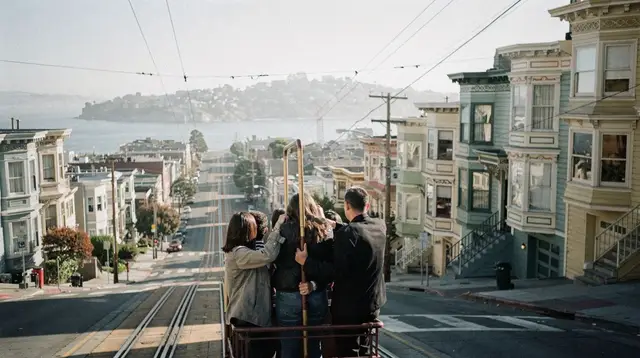
A guided cable car tour, such as the cable car app-guided tour, uses San Francisco’s National Historic Landmark cable car system with narrated commentary via a phone app. It’s worth being clear about what this format does and doesn’t deliver: the cable car itself is a slow, historic funicular, not a fast way to cross the city, and a single one-way ride costs a flat $8 with no transfers, as explained in the how cable cars work explainer. Treat a cable car tour as a themed experience along one or two lines (Powell-Hyde, Powell-Mason or California Street) — closer to a walking tour in scope than to a full city bus tour — rather than a substitute for either.
Walking tours: depth over breadth, one neighborhood at a time
Walking tours trade citywide coverage for depth in a single area, and San Francisco has several neighborhoods dense enough to reward it. The downtown guided walking tour focuses on the Financial District, Union Square and the streets around them — the compact historic and commercial core — with a guide able to stop, explain and answer questions in a way no moving vehicle allows.
Two other neighborhoods are commonly covered by dedicated walking tours rather than folded into a citywide route: Chinatown, detailed in the Chinatown walking tour guide, and North Beach, in the North Beach walking tour guide. Both are compact, walkable on relatively flat ground compared to the rest of the city, and dense with things a bus would drive straight past — alleyways, murals, specific bakeries and family-run shops.
Travelers who prefer to set their own pace entirely, with no fixed schedule or guide, can also build a route from the self-guided walking tour of San Francisco, though without a guide’s local context and stories.
Matching the format to your trip
- One day in San Francisco, first visit: a bus or van city tour, to see the widest range of landmarks with no walking-distance constraint.
- Two or more days: a bus tour on day one for orientation, then a walking tour of Chinatown or North Beach on a later day once you know which neighborhood you want to revisit — see the two-day highlights itinerary.
- Traveling with young children or limited mobility: a private van tour, which removes walking distance and lets the group set the pace.
- Active travelers who want to cover ground under their own power: a guided e-bike tour, especially one that crosses the Golden Gate Bridge.
- A tight budget and flexible schedule: a hop-on hop-off pass, which spreads the cost of city-wide access across a full day or two.
- Interest in one specific landmark experience: a cable car tour, understood as an experience rather than transport.
Practical notes before booking
Whichever format you choose, a few points from San Francisco’s own logistics apply across the board. Prices shown at booking exclude sales tax, which runs about 8.625% in San Francisco in 2026, and a tip is customary on services with a guide, typically in the same range as restaurant tipping. San Francisco’s summer (June-August) is its foggiest, coolest season in the fog belt — pack a layered jacket regardless of which tour format you pick, since bus tours stop outdoors at several points and both bike and walking tours are fully exposed. September and October, sometimes called the city’s “second summer,” offer the most reliable warm, clear weather for outdoor formats.
None of the formats above include Alcatraz, which runs on its own timed ferry system sold exclusively by the National Park Service’s authorized concession — details and booking timing are in the Alcatraz tickets guide. If a city overview and an Alcatraz crossing both matter to your itinerary, plan them as two separate bookings rather than expecting one tour to cover both, since Alcatraz tickets sell out weeks in advance and need to be reserved on their own schedule.
Frequently asked questions about San Francisco city tours
Is a bus tour or a walking tour better for seeing San Francisco in one day?
A bus or van tour covers more distance in less time, which matters because San Francisco’s main sights — the Golden Gate Bridge, Fisherman’s Wharf, Twin Peaks, the Mission — are spread across steep hills several kilometres apart. Save walking tours for one compact neighborhood.
Do city tours include Alcatraz?
Most standard city tours do not include Alcatraz, since the island requires a separate timed ferry ticket sold exclusively by Alcatraz City Cruises. Some combo tours pair a city overview with an Alcatraz crossing; check the itinerary before booking.
How long does a typical San Francisco city tour last?
Most guided bus or van city tours run 3 to 4 hours, hop-on hop-off passes are valid for a full day (sometimes 48 hours), and walking tours of a single neighborhood typically last 2 to 3 hours.
Can I do a city tour without a car?
Yes — every format covered here (bus, van, e-bike or walking) is run by an operator with its own vehicle or route, so visitors never need to drive or park, which suits San Francisco’s scarce and expensive downtown parking.
Is a private city tour worth the extra cost?
A private tour costs more per person but lets the group set the pace, skip stops that don’t interest them, and travel in a smaller vehicle that can reach spots a full-size bus can’t, which suits families, mobility needs or a tight schedule.
What should I wear on a walking or bike city tour?
Layers and comfortable, broken-in shoes, even in summer — San Francisco’s fog belt runs several degrees cooler and windier than inland neighborhoods on the same day, and hills mean more elevation change than the flat distance suggests.
Do city tours run in the rain or fog?
Bus and van tours generally run regardless of weather since guests stay under cover for most of the route. Walking and bike tours usually still run in light rain or fog but may be rescheduled in heavy storms; check the operator’s weather policy at booking.
San Francisco and Fisherman's Wharf Tours
Verified deep-linked GetYourGuide tours. Book through these links and we earn a small commission at no cost to you.
GetYourGuide does not provide a product photo for this activity — the image shows the meeting point, photographed by us.