Wine Country Transportation: Shuttle, Limo, Bike or Designated Driver
What's the best way to get around Napa or Sonoma wine country without driving?
A private shuttle or chauffeured car is the most flexible no-driving option for a small group, a guided small-group tour is the cheapest per person, and an e-bike works well for visitors who want to move between two or three nearby wineries under their own power. Renting a car and designating a sober driver only makes sense if that person is genuinely willing to skip tasting at most stops.
The real question isn’t “should I drive,” it’s “who’s driving”
Napa Valley and Sonoma are roughly 1 to 1.5 hours from San Francisco by car, with no direct train to either. That single fact shapes almost every transportation decision visitors make: there’s no train station to walk out of and start tasting, so someone has to get you there, get you between wineries once you arrive, and get you home again — and that someone can’t be the person doing the tasting. California’s legal blood alcohol limit for driving is 0.08%, and a flight of four or five pours at even one winery can push a driver close to or over that line, long before a second or third stop.
That’s the trade-off underneath every option on this page. A rental car is cheap and flexible but requires a designated driver who mostly doesn’t drink. A shuttle or private car removes that problem entirely but costs more. A guided small-group tour splits that cost across strangers. A bike works for short, flat hops between two or three wineries but not for a full day covering a spread-out valley. None of these is objectively “best” — the right one depends on group size, budget, how many wineries you actually want to taste at, and whether you’re doing Napa or Sonoma in one day, since most people pick one valley per outing rather than trying to combine both.
Option 1: Private shuttle or car service
A private shuttle, SUV or sprinter van with a driver is the closest thing to a rental car without the sobriety problem. You set the itinerary — often with a driver who knows the region well enough to suggest routing — and everyone in the group can taste freely.
Pros:
- No one has to skip tasting or stay sober all day.
- Flexible stops and timing; you’re not locked into a fixed group tour schedule.
- Works well for families or groups who want privacy rather than sharing a vehicle with strangers.
- Door-to-door from a San Francisco hotel, which avoids the Golden Gate Bridge toll and parking headaches entirely, since the driver handles both.
Cons:
- The most expensive per-person option for small groups; it becomes more cost-effective as the group grows toward 6-10 people who can split a larger vehicle.
- Requires advance booking, especially for weekends in peak season (roughly April through October).
- Some operators have minimum-hour requirements (commonly 6-8 hours), so a short half-day visit may cost close to what a full day would.
A private car or SUV service is generally quoted by the hour with a multi-hour minimum, and tasting fees are always separate — plan on $35-75 per standard tasting and up to $200+ for reserve experiences on top of the transportation cost. For groups who want this level of flexibility without arranging it themselves, a private Napa and Sonoma valley wine tour builds the day around a dedicated vehicle and driver rather than a fixed shared itinerary.
Option 2: Limousine or stretch/party vehicle
A stretch limo, party bus or similar vehicle is the classic choice for bachelor/bachelorette groups, birthdays and other celebrations. Functionally it solves the same problem as a private shuttle — a sober driver who isn’t you — but the vehicle itself is part of the experience.
Pros:
- Built for a festive, group-celebration atmosphere; sound systems, standing room and open layouts are common.
- Same no-driving benefit as a private shuttle.
- Can feel more “occasion-appropriate” for milestone celebrations than a standard SUV.
Cons:
- Typically the highest hourly rate of the no-driving options, especially for a full stretch limo versus an SUV or van.
- Less practical for narrow winery driveways or smaller, family-run tasting rooms that a stretch vehicle can’t easily access.
- Not ideal for visitors who want a quieter, more contemplative wine country day rather than a party atmosphere.
If a limo is the plan, confirm with the winery in advance that a stretch vehicle can actually park at each stop — some smaller Napa and Sonoma producers have tight driveways that only accommodate SUVs or sedans.
Option 3: Guided small-group tour
A seated small-group tour, typically in a van or minibus with a set itinerary and a handful of pre-selected wineries, is usually the cheapest per-person no-driving option, because the cost of the vehicle and driver is split across all the guests, not just your own party.
Pros:
- Lowest per-person cost among fully chauffeured options.
- No planning required — the itinerary, winery selection and pacing are handled for you.
- A knowledgeable guide often adds context on the region, grape varieties and history that a plain shuttle driver wouldn’t.
- Easy to book close to your travel date compared with sourcing a private vehicle.
Cons:
- Fixed itinerary — you can’t swap in a specific winery you wanted to visit, or linger longer at one that surprised you.
- Shared with other travelers, which some groups (especially couples or families) prefer to avoid.
- Pickup times and group pacing are less flexible than a private vehicle.
A custom-built Napa and Sonoma valley wine tour sits between a fully private car and a rigid group itinerary, letting you weigh in on winery selection while still sharing the cost structure of a guided tour. It’s a reasonable middle ground for visitors who want some input without arranging every stop themselves.
Option 4: Bike or e-bike
For a specific kind of wine country day — a handful of wineries clustered close together on relatively flat terrain — a bike or e-bike is a genuinely good option, not just a novelty. Several dedicated bike paths and quiet backroads connect clusters of tasting rooms in both valleys.
Pros:
- Active, outdoor and scenic in a way no vehicle option offers.
- No driver to coordinate or pay for; you set your own pace between stops.
- E-bikes flatten the effort required for the valley’s gentle grades, making longer routes realistic for riders who aren’t in serious cycling shape.
- Often the cheapest transportation option after tasting fees.
Cons:
- Only practical for wineries genuinely close together — this is not a way to cover a spread-out, full-valley itinerary in one day.
- Riding after multiple tastings is a real safety concern; the responsible approach is the same as with a car — pace tastings carefully, and consider having only one or two stops involve actual pours.
- Weather-dependent: summer afternoons and any rain change the calculus.
- Getting the bike itself to and from the valley (rental pickup location, drop-off logistics) needs to be planned in advance.
An e-bike tour along the Napa Valley Vine Trail with a picnic lunch keeps the ride flat and the stops close together, which suits visitors who want the scenery without the effort of pedaling a standard bike between wineries.
If none of this is quite right, a fuller guided cycling day covers more ground for visitors who want a more athletic pace: a full-day guided Napa-Sonoma cycling tour is built around routes and rest stops rather than a fixed winery list, letting a guide handle the pacing and road safety.
Option 5: Rent a car and designate a driver
This is the option most visitors default to without thinking it through, because it’s how they’d approach almost any other day trip. It can work, but only if the designated driver genuinely accepts a mostly-sober day.
Pros:
- Cheapest raw transportation cost if you already have the rental (roughly $45-95+ per day depending on season and demand) and are stopping in wine country as part of a longer road trip.
- Full flexibility to change plans, linger, or detour without coordinating with a driver or tour schedule.
- Makes sense if the day includes non-drinking stops too — scenery, a picnic, shopping — not just tasting rooms.
Cons:
- Someone has to skip most or all of the tasting, which for many visitors defeats the purpose of the trip.
- Reservations are increasingly expected at Napa tasting rooms especially, and average fees (around $79 in Napa, somewhat less in Sonoma) sting more when one person in the car isn’t drinking what they paid for.
- Rotating “who’s driving” between multiple people across the day is common but creates its own coordination overhead and is easy to get wrong after a long lunch.
- Parking at popular wineries fills up on weekends, adding friction a chauffeured option avoids entirely.
If self-driving is the plan regardless, read up on the drive from San Francisco to Napa Valley beforehand, and build in real slack — traffic on Highway 29 and the Silverado Trail backs up badly on weekend afternoons.
Side-by-side comparison
| Option | Best for | Typical cost pattern | No-driving? |
|---|---|---|---|
| Private shuttle/car | Small-to-medium groups wanting flexibility | Hourly, multi-hour minimum; cheaper per person as group grows | Yes |
| Limo/party vehicle | Celebrations, group energy | Highest hourly rate of chauffeured options | Yes |
| Guided small-group tour | Solo travelers, couples, budget-conscious groups | Lowest per-person cost among chauffeured options | Yes |
| Bike/e-bike | Clustered wineries, active travelers | Rental fee only, no driver cost | Partially — ride responsibly between tastings |
| Rental car + designated driver | Longer road trips, non-drinking stops | Cheapest raw cost, but one person tastes little or nothing | No |
Napa vs. Sonoma: does the transportation choice change?
Not fundamentally, but distances differ slightly. Napa Valley wineries run along a narrow, roughly 30-mile corridor (Highway 29 and the Silverado Trail), which suits both shuttles and bike routes well. Sonoma is more spread out across several distinct sub-regions, which tends to favor a private vehicle or guided tour over biking unless you’re sticking to one cluster, such as around Sonoma Plaza or Healdsburg. Because the two valleys are separated by a mountain range with no fast direct road, virtually every transportation option — shuttle, tour or self-drive — is built around visiting one valley per day, covered in more detail in the Napa and Sonoma wine country weekend itinerary.
Booking and reservations matter more than the ride
Whichever transportation option you choose, it solves getting between wineries — it doesn’t solve getting into them. Reservations are increasingly expected, especially in Napa, and showing up without one at a popular producer on a weekend can mean being turned away regardless of how you arrived. Build your winery list and confirm reservations before locking in transportation, not after; the wine tasting reservations guide walks through how far ahead to book and what to expect on cost.
Budgeting the full day, not just the ride
Transportation is only one line item. A realistic day should also budget for tasting fees at each stop (commonly $35-75 standard, $75-200+ for reserve tastings), lunch, and tips for both the driver or guide and tasting-room staff. For a broader sense of what a wine country day adds to a San Francisco trip overall, the San Francisco trip budget guide breaks down typical daily spending ranges. If wine and food pairing is the priority over covering many wineries, a dedicated pairing experience such as those covered in the Napa Valley food and wine pairing tours guide may be worth building the transportation plan around instead of a high winery count.
Practical booking timeline
- 1-2 weeks ahead (minimum for weekends, April-October): Lock in a shuttle, limo or guided tour. Popular operators and vehicles sell out earlier in peak season.
- Same window: Confirm winery reservations for any producer that requires them, especially in Napa.
- A few days ahead: Reconfirm pickup time and location with your driver or tour operator, and check the day’s weather if biking.
- Day of: Build slack into the schedule — traffic on the main valley roads is worst on Saturday and Sunday afternoons, regardless of transportation choice.
Getting around wine country and back to San Francisco
For visitors weighing this decision against Sonoma or Napa as one of several possible day trips from the city, it helps to see it alongside what actually works as a day trip from San Francisco versus what doesn’t. Whichever option you choose — chauffeured, guided, pedaled or self-driven with a designated driver — the goal is the same: everyone who wants to taste gets to taste, and everyone gets home safely at the end of the day.
Frequently asked questions about wine country transportation
Can I drive myself to wine country and just drink less?
California’s legal limit is 0.08% blood alcohol, and it’s easy to underestimate how quickly several tasting pours add up, especially on an empty stomach. Most visitors who drive themselves end up skipping tastings at all but one or two wineries, which defeats the point of the trip.
Is a shuttle or a limo more expensive for a group?
For four to six people splitting the cost, a private shuttle or SUV service and a limo often land in a similar daily range, roughly $600-1,400 depending on hours and vehicle, though a stretch limo typically has a higher hourly rate than an SUV or sprinter van shuttle. Getting a same-day quote from a few operators is the only reliable way to compare, since pricing shifts by season and day of week.
Do wine country shuttles include tasting fees?
Usually not. Shuttle, limo and small-group tour prices almost always cover transportation only; tasting fees are paid separately at each winery, commonly $35-75 for a standard tasting and $75-200+ for a reserve experience.
Is biking a realistic way to visit wine country?
Yes, over short distances between a handful of wineries on flatter routes, especially with an e-bike, but it isn’t a full substitute for a car if the plan includes wineries spread across a valley or a return trip that ends after dark or after drinking.
Can I combine Napa and Sonoma in one day using a shuttle or tour?
It’s possible but not recommended. The two valleys are separated by a mountain range with no direct fast road between them, so most transportation options, including guided tours, are built around a single valley per day rather than both.
How far in advance should I book wine country transportation?
For weekends, especially April through October, book a shuttle, limo or guided tour at least one to two weeks ahead; last-minute availability shrinks fast and prices tend to rise closer to the date.
Do I need to tip a wine country driver or tour guide?
Yes. It isn’t built into the quoted price. A common range is 15-20% of the transportation cost for a private driver, or $10-20 per person for a small-group tour guide, on top of whatever tip is expected on food and tasting-room service.
Getting Around San Francisco
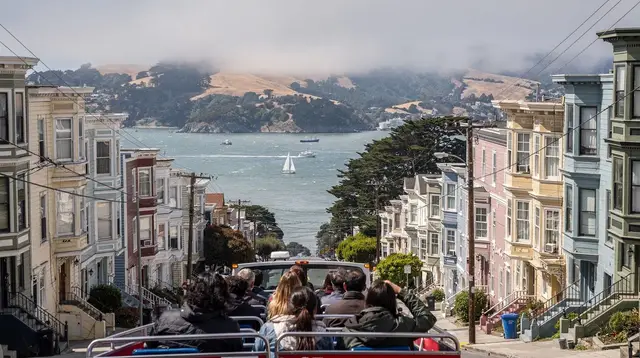
Verified deep-linked GetYourGuide tours. Book through these links and we earn a small commission at no cost to you.
GetYourGuide does not provide a product photo for this activity — the image shows the meeting point, photographed by us.