Yosemite vs Lake Tahoe: Which Trip From San Francisco?
Is Yosemite or Lake Tahoe better as a trip from San Francisco?
Yosemite suits hikers and waterfall/granite scenery chasers and needs at least one overnight to be worth the 3.5-4.5 hour drive. Lake Tahoe suits beach, boating and ski trips, is a similar drive via I-80, and works better if you want a lake-focused, more relaxed multi-day stay.
Both sit roughly 3.5 to 4.5 hours from San Francisco by car, and both get pitched constantly as “the” weekend escape from the city. They are not interchangeable trips. One is a granite-and-waterfall national park built around hiking and valley scenery; the other is a 22-mile alpine lake ringed by beach towns, casinos and ski resorts. Picking wrong means either a rushed dash through a park that deserved an overnight, or a lake trip spent staring at trailheads instead of water.
This guide lines the two up directly — drive time, scenery, activities, cost, season — so the choice takes five minutes instead of a week of open browser tabs.
The short version
Pick Yosemite if you want waterfalls, granite cliffs (El Capitan, Half Dome), valley-floor and high-country hiking, and you’re travelling roughly April through October when the falls and high roads are open.
Pick Lake Tahoe if you want a lake — swimming, kayaking, boating, beaches — in summer, or skiing and snow sports in winter, and you’d rather split your time between water and small lakeside towns than commit to a single park’s trail network.
Pick neither as a day trip. Yosemite round-trip driving alone commonly runs 7-9 hours, and Tahoe only works as a single-stop lookout day, not a real beach or ski day. Both reward at least one overnight from San Francisco. Anyone still tempted to squeeze either park into a single day should read our Yosemite day trip reality check first — the driving math rarely works out the way it looks on a map.
Distance and drive time from San Francisco
| Yosemite Valley | Lake Tahoe (South Shore) | |
|---|---|---|
| Driving distance | About 3.5-4.5 hours one-way | About 3.5-4 hours one-way |
| Route | Highway 120 or 140 | I-80 |
| Winter driving | Tioga Road (120) closes; use 140, expect chains | I-80 stays open but chains/snow tires often required |
| Realistic day trip? | No — 7-9 hours round trip, little park time | Only for one lookout stop, not a beach/ski day |
| Train/bus option | None direct; car is the practical option | None direct; car is the practical option |
Both are close enough in drive time that distance alone won’t decide it — the deciding factor is what you actually want to do once you arrive. For the fuller breakdown of routes, timing and seasonal road closures, see our Yosemite from San Francisco planning guide. For a broader introduction to each place before committing to either trip, see the full Yosemite destination guide and Lake Tahoe destination guide.
Scenery and character
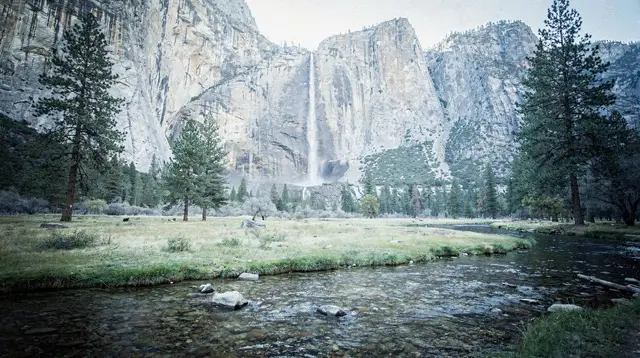
Yosemite is defined by scale: granite walls rising straight out of a flat valley floor, waterfalls (Yosemite Falls, Bridalveil Fall) that run at their fullest during spring snowmelt, and sequoia groves in the park’s southern reaches. It’s a hiking-first landscape — even a short walk from the valley floor puts you under some of the tallest cliff faces in North America. For trail options across skill levels, the Yosemite hiking trails guide breaks down valley-floor walks versus multi-hour climbs.
Lake Tahoe is defined by water: a deep, cold, startlingly blue alpine lake with beaches, marinas and small towns (South Lake Tahoe, Tahoe City, Truckee) around its shore. The scenery rewards being on or near the water — kayaking, paddleboarding, boat tours — as much as hiking the surrounding Sierra peaks. It’s a more social, resort-town atmosphere than Yosemite’s park-and-trailhead structure.
Activities compared
| Activity | Yosemite | Lake Tahoe |
|---|---|---|
| Hiking | Iconic, dramatic — granite domes, waterfalls | Strong alpine hiking, less iconic |
| Water sports | Limited — river sections, no real lake | Core activity — kayaking, boating, paddleboarding |
| Skiing/snow sports | Seasonal roads close in winter | Full winter resort season |
| Rock climbing | World-famous (El Capitan) | Limited by comparison |
| Wildlife viewing | Black bears, deer, high-country species | Similar Sierra wildlife, more lakeside birdlife |
| Town/resort atmosphere | Minimal — park lodging only | Full towns, casinos, dining, nightlife |
| Family-friendly stroller routes | Some valley-floor paved trails | Beach access, easier flat walks |
Yosemite’s headline activity is on foot: valley floor loops for a first visit, or the demanding cables route up Half Dome for experienced hikers with a permit. Guided access also exists — the day tour from San Francisco covers the valley’s highlights without driving yourself, and travellers who want climbing culture rather than a hike can watch a guided look at El Capitan’s climbing history.
Lake Tahoe’s headline activity is on the water. A clear-bottom kayak trip on the lake is a distinctly Tahoe experience that has no Yosemite equivalent, and for a wider view of the basin, a small-plane flight over Lake Tahoe shows the full shoreline and surrounding peaks in a way no ground route can. Winter tips the balance further toward Tahoe; see the Lake Tahoe ski resorts guide for the resort options.
Best season for each
Yosemite peaks in spring (roughly April through June), when snowmelt feeds the waterfalls at full flow. By late summer and into September, some falls that looked spectacular in a May photo can slow to a trickle or dry entirely. Tioga Road and Glacier Point Road — the park’s high-country routes — close under snow each winter and typically reopen only in mid-to-late May; in 2026, Glacier Point Road opened May 9 and Tioga Road May 15. Entry in 2026 has no peak-hours reservation system, just the standard $35-per-vehicle, 7-day entrance fee (card only), plus a $100-per-person fee for international visitors 16 and older since January 1, 2026 — but arriving before 8am is still the practical way to beat full parking lots on summer weekends.
Lake Tahoe effectively has two high seasons. Summer (June through September) is for the lake itself — swimming, boating, hiking the surrounding trails. Winter (roughly December through March) is ski season, when the park’s own seasonal roads close but Tahoe’s resorts are in full swing. Spring and autumn are shoulder seasons at Tahoe, quieter but with less to do on the water or the slopes. For a closer look at what winter actually looks like at the lake, see snow in Lake Tahoe, and for entry logistics on the Yosemite side, the Yosemite entry permits and passes guide covers fee changes and any reservation requirements before you go.
Getting there without your own car
Not everyone wants to rent a car and drive three-plus hours through unfamiliar mountain roads, and both destinations have alternatives to self-driving. From San Francisco, a full-day guided option like the Enchanted Lake Tahoe day tour handles the I-80 drive and delivers a full day at the lake without touching a rental counter. Travellers combining several Northern California highlights into one longer trip sometimes prefer a multi-day guided loop instead, such as the four-day Los Angeles to San Francisco route covering Yosemite, Big Sur and the 17-Mile Drive, which folds Yosemite into a wider regional itinerary rather than treating it as a standalone trip. Self-driving still gives the most flexibility for either destination once you’re ready to plan the route yourself — see the Yosemite road trip and car rental guide or the Lake Tahoe day trip logistics guide for the practical details, from chain requirements to realistic driving windows.
Can you do both?
Yes, in the right season. Tioga Road (Highway 120) runs through Yosemite’s high country and is the shortest link toward the Tahoe basin, so a loop — San Francisco to Yosemite, over Tioga Road, on to Lake Tahoe, back to San Francisco via I-80 — is a genuinely workable multi-day itinerary roughly mid-May through the first heavy autumn snowfall. Outside that window, Tioga Road is closed and the two parks require separate trips, each looping back through San Francisco. Our Yosemite and Lake Tahoe multi-day tour guide lays out a realistic pacing for combining them, and travellers based at Tahoe rather than the city can also reach the park directly via a Yosemite day trip departing from Lake Tahoe, which cuts the drive roughly in half compared with starting in San Francisco.
Cost comparison
| Yosemite | Lake Tahoe | |
|---|---|---|
| Park/lake entry | $35 per vehicle (7 days), +$100/person for international visitors 16+ | Free — no lake entry fee |
| Typical lodging | Limited in-park options, book far ahead; more choice in gateway towns (Oakhurst, Mariposa) | Wide range — South Lake Tahoe, Tahoe City, Truckee |
| Car rental | Genuinely useful for both — see the road trip guide below | Same |
| Guided day tour from SF | Roughly $150-250+ per person, varies by operator | Fewer direct SF day tours; most visitors self-drive or fly into Reno |
| Activity costs | Hiking is free; permits needed for Half Dome cables | Kayak/boat rentals, ski lift tickets add up quickly in winter |
Renting a car makes sense for either trip, and the same road-trip planning applies to both — practical notes on routes, chains and rental logistics are in the Lake Tahoe road trip car rental guide. For a longer stay built around Yosemite specifically, a private guided option like the private two-day Yosemite tour removes the driving and planning entirely, and families weighing flexibility over a fixed itinerary may prefer the customizable private Yosemite family tour, which adapts pacing to kids and mixed fitness levels.
Accessibility and difficulty
Yosemite’s valley floor has several paved, relatively flat paths suitable for strollers and wheelchairs (Lower Yosemite Fall, Cook’s Meadow), but its most famous views — Half Dome, Glacier Point, high-country trails — require real hiking and elevation gain. The Yosemite accessibility guide has the detail on which valley trails, shuttles and viewpoints work for wheelchair users and limited-mobility visitors. Lake Tahoe’s shoreline paths and beaches are generally easier for mixed-mobility groups, though ski season activities are naturally more physically demanding and gear-dependent; families planning around younger kids rather than mobility may find the family-friendly Lake Tahoe guide more useful for pacing a visit.
Multi-day itinerary ideas
If the choice really is either/or rather than both, it helps to see how each destination slots into a longer trip rather than comparing them in isolation. A Yosemite in two days itinerary is close to the minimum for seeing the valley floor and at least one high-country viewpoint without rushing between them. On the Tahoe side, a winter weekend in Lake Tahoe itinerary pairs naturally with the ski season discussed above, while travellers visiting outside snow season may prefer the general pacing of a hiking and nature escape from San Francisco itinerary, which works for either park’s trail network. For those who genuinely have the time for both, a seven-day San Francisco, Yosemite and Tahoe itinerary or the broader six-day Northern California loop each build in the Tioga Road link described above, turning the either/or comparison into a single connected trip.
Bottom line
Both are worth a multi-day trip from San Francisco, and neither works well squeezed into a single rushed day. Yosemite rewards hikers chasing dramatic, singular scenery on a spring or summer trip; Lake Tahoe rewards travellers who want a lake-and-town base with activity options that shift between summer water sports and winter skiing. If your schedule and the season allow it, linking them via Tioga Road turns the either/or into a single northern California loop — otherwise, pick based on whether you’d rather be standing under a waterfall or paddling across a lake.
Yosemite vs Lake Tahoe FAQ
Can I visit both Yosemite and Lake Tahoe on the same trip?
Yes — Yosemite and Lake Tahoe are connected by Tioga Road (Highway 120) inside the park, open roughly mid-May to the first heavy snowfall, making a loop feasible in summer and early autumn without backtracking through San Francisco.
Which is closer to San Francisco, Yosemite or Lake Tahoe?
They’re similar: Yosemite Valley is about 3.5-4.5 hours by car via Highway 120 or 140, and South Lake Tahoe is about 3.5-4 hours via I-80, both longer in winter or holiday traffic.
Is Yosemite or Lake Tahoe better for a day trip from San Francisco?
Neither is a comfortable day trip. Yosemite as a round trip is commonly 7-9 hours of driving alone, leaving little time in the park. Lake Tahoe is a realistic long day trip only for a single lookout stop, not a real beach or ski day — both reward at least one overnight.
Do I need a permit or reservation to enter Yosemite in 2026?
No peak-hours vehicle reservation system is in place for 2026; entry is by standard entrance fee only ($35 per vehicle for 7 days, card payment only), though arriving before 8am is the practical way to beat full parking lots and queues in Yosemite Valley on summer weekends.
Is Lake Tahoe or Yosemite better for skiing or winter activities?
Lake Tahoe, decisively — its resorts operate full winter seasons, while Yosemite’s own seasonal roads (Tioga Road, Glacier Point Road) close under snow each winter and reopen only in late spring.
Which has better hiking, Yosemite or Lake Tahoe?
Yosemite is the destination for iconic, dramatic hiking — granite domes, waterfalls and valley-floor trails. Lake Tahoe offers strong alpine hiking too, but its trip is more balanced around the lake itself: boating, beaches and lakeside towns alongside the trails.
What’s the best time of year to visit Yosemite versus Lake Tahoe?
Yosemite peaks in spring (roughly April-June) for waterfalls at full flow. Lake Tahoe splits into two high seasons — summer for the lake and beaches, winter (roughly December-March) for skiing — with Tioga Road connecting the two parks only outside the snow season.
Tour Comparisons
Verified deep-linked GetYourGuide tours. Book through these links and we earn a small commission at no cost to you.
GetYourGuide does not provide a product photo for this activity — the image shows the meeting point, photographed by us.